A brain-computer interface can turn brain signals into robot commands, but it does not read a full thought like a sentence on a screen. The useful question is narrower: can a person control a robot arm, wheelchair, or cursor without moving their body?
- Brain signals can stand in for movement commands such as left, right, open, or stop.
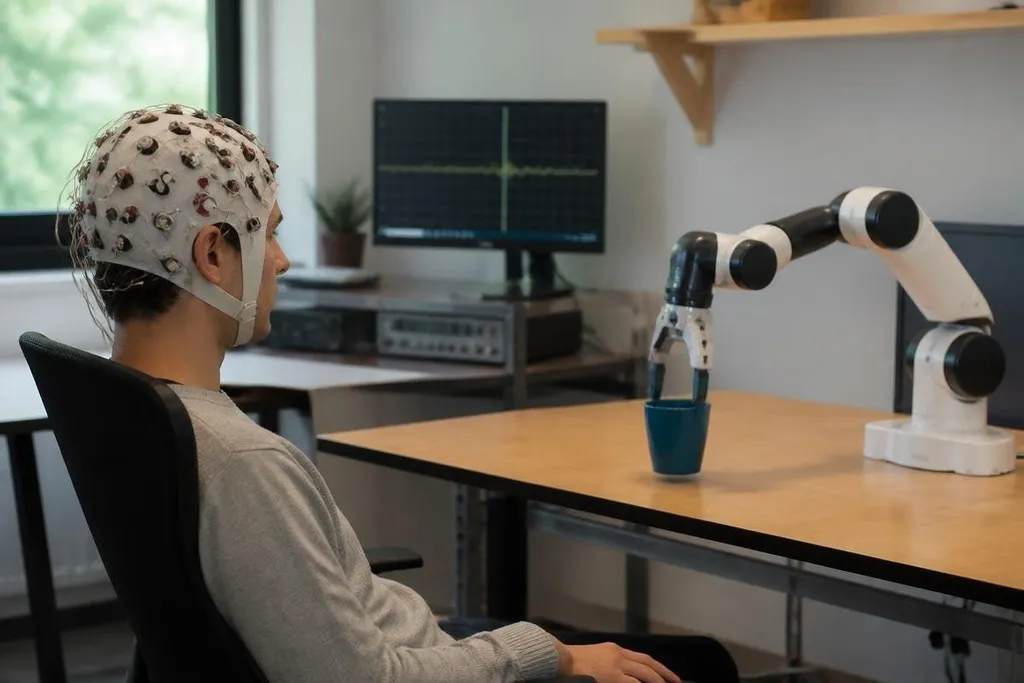
- Electroencephalography, or EEG, reads activity through sensors on the scalp; implanted electrodes read closer to the source.
- The robot still needs software to filter signals, check intent, and handle unsafe commands.
What the robot actually receives
The robot receives a signal, not a thought. A BCI measures electrical activity linked to an intended action, then a computer sorts that activity into a small set of commands.
For example, a system may learn the signal linked to moving a cursor left. The person repeats that task while the computer records the brain activity. Software then compares new signals with the learned patterns and sends a command to the robot.
That process needs training. A user must produce a similar signal many times, and the software must cope with noise from eye movement, muscle movement, poor sensor contact, and changes in attention.
A command that works at a desk may need fresh setup after the sensors move.
The robot also needs a safety layer. It can slow down, ask for confirmation, limit the arm's reach, or stop when the signal becomes unclear. Those checks matter because a false command near a person or a sharp tool has a physical cost.
EEG and implanted electrodes
EEG is the easier route to test because sensors sit on the scalp. The trade-off is signal quality: the skull and skin spread the electrical activity before the sensors record it, which makes precise control harder.
Implanted electrodes sit closer to the brain's electrical signals. That can give software a cleaner input, but surgery adds medical risk, recovery time, and long-term care. A robot system may work better with that signal, yet the device must still meet medical and safety rules.
Neither method turns a robot into an independent mind. The person supplies an intended command, while software translates it and the robot handles the physical motion. That division matters when a buyer asks if thought control can replace a joystick, teach a robot new tasks, or let someone with limited movement use a machine.
Where this helps today
Thought control makes the most sense when ordinary controls are hard to use. A person with severe movement limits may send a small set of commands without moving a hand. A worker could use hands-free control in a task where touch controls create another hazard, though that case needs careful testing before use around moving equipment.
The command set will usually be small at first. A robot that accepts stop, start, left, right, and grip commands is easier to check than one asked to interpret open-ended intent. More commands mean more patterns for the software to separate, and more chances for a wrong choice.
Brain-controlled robots need two separate records: what the signal meant in the lab and how the robot behaved near people, tools, or moving equipment. Robot24.com robotics reporting can connect those claims to named systems, test settings, and measured results before the limits buyers should ask about.
The limits buyers should ask about
A short demonstration can hide the hard parts. Ask how many commands the system supports, how often a person must retrain it, and what happens when the signal drops. Ask if the robot stops on its own or waits for another command.
The source of the signal matters too. A scalp sensor may be easier to wear, while an implant may need surgery. The article, product page, or study should name the sensor type and explain the test setting before you compare results.
I’d skip any system that treats a smooth demo as proof of safe daily use.
Use this checklist before taking a thought-controlled robot seriously:
- Name the input: EEG, implanted electrodes, or another sensor system.
- Count the commands: record the exact actions the robot can accept.
- Check the failure response: find out what happens when the signal is noisy.
- Look for repeated trials: one successful run says little about daily use.
- Separate control from autonomy: note which actions the person commands and which the software handles.
- Price the full setup: include training, sensor fitting, software, service, and safety hardware.
What happens next
The next useful step is not a robot that obeys every private thought. It is a system that handles a small command set, reports uncertainty, and stops safely when the signal does not fit.
That standard gives buyers a clear test: ask for repeatable control, named hardware, failure data, and a safe stop. Until those details are public, thought-controlled robots belong in careful trials rather than routine work.